
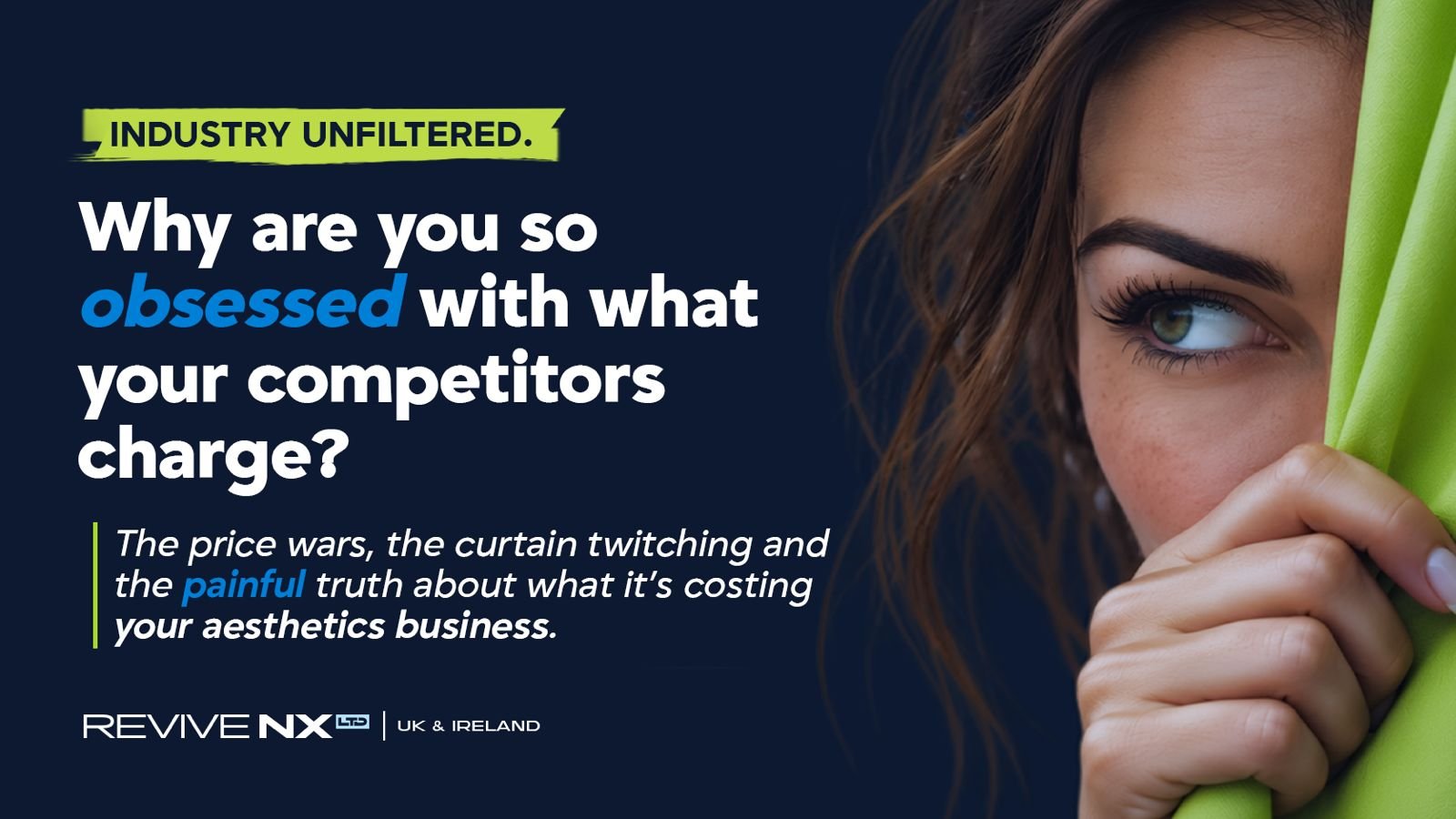
Seriously. Why?
Price wars, curtain twitching, and the painful truth about what it’s costing your aesthetics business.
You know the type. Every neighbourhood has one. The curtain twitcher who knows who’s coming, who’s going, whose car is parked outside and what time the neighbours got home last night. Nothing gets past them. They’re practically running neighbourhood surveillance from behind a pair of net curtains.
And sometimes, that’s a good thing. They look out for their neighbours, notice suspicious behaviour and help keep their community safe.
But there’s a difference between keeping an eye on the neighbourhood and making everyone else’s business your full-time occupation.
Welcome to the aesthetics industry, where curtain twitching has become something of a professional pastime.
You know exactly what we’re talking about. The practitioner who’s constantly monitoring the clinic down the road, checking their treatment prices, scrolling through their Instagram, discussing them with clients, bringing them up at training events and keeping the conversation going across professional forums, WhatsApp groups and social media.
They’re charging £90. You’re charging £290.
And suddenly, the accusations start flying. They must be incompetent. They can’t possibly be properly trained. Their products must be illegal. Their treatments must be unsafe.
Yadda, yadda, yadda.
All because somebody has advertised a cheaper treatment.
Legitimate concerns about unsafe practice, misleading claims, or professional misconduct absolutely deserve attention. Protecting clients and maintaining professional standards matter. But assuming someone’s competence based entirely on their price list is another matter.
And here’s the question nobody seems particularly keen to answer.
What’s all that watching actually doing for YOUR business?
Their Prices Are Their Business.
Your Performance Is Yours.
Let’s talk about the £90 versus £290 argument, because it regularly gets people talking in aesthetics.
If you believe in your products, techniques, knowledge and results, why does another practitioner’s pricing bother you quite so much?
Perhaps you’ve invested thousands in education, developed specialist techniques, sourced high-quality products and spent years building your reputation. Naturally, you want your prices to reflect that investment.
But someone else charging less doesn’t automatically undermine the value of what you offer.
Think about the hotel industry. Does Hilton need to become Travelodge because Travelodge offers rooms at a lower price? Does British Airways need to abandon its First Class experience because Ryanair sells cheaper flights?
Of course not. They offer different experiences, operate different business models, and appeal to customers with different priorities.
And the same applies to aesthetics.
Every business has its audience. Every price point has its market. Some clients prioritise affordability; others prioritise specialist expertise, convenience, experience, or a particular treatment approach. Many consider a combination of all of them.
Are you genuinely concerned about their pricing, or are you concerned they’re appealing to clients you thought should be yours?
Because those are two very different conversations.
And if their pricing genuinely works for them, good for them. They might have lower overheads, excellent purchasing arrangements, an efficient treatment model and a fully booked diary. They might be making perfectly healthy profits.
You don’t know.
You can see their advertised price, but you can’t see their accounts, margins, operating costs, or what happens behind the treatment-room door.
So why are you so convinced you know how their business works?
Cheap Prices, Expensive Problems?
Now, let’s talk about something that actually matters: profitability.
Attracting price-sensitive clients through unsustainably low pricing can create expensive problems for the business.
If you’re constantly reducing your prices to compete, without properly understanding your costs, you may find yourself performing more treatments to generate the same profit.
More appointments. More consumables. More administration. More pressure on your time. And potentially less money available for education, equipment, product development, marketing and reinvestment.
You can be fully booked and still be struggling financially.
There’s nothing particularly glamorous about working yourself into the ground for a diary full of appointments that barely cover your costs.
And if your entire business proposition is being the cheapest, what happens when someone else comes along and charges even less?
Of course, lower pricing isn’t automatically unsustainable. A practitioner with an efficient business model, appropriate costs and strong client retention may be doing extremely well. Equally, premium pricing doesn’t guarantee profitability.
The point is that being busy and building a profitable, sustainable business are not necessarily the same thing.
And before you decide that every client looking for a cheaper treatment is going to be difficult, remember that affordability matters to people for legitimate reasons.
A price-sensitive client isn’t automatically a problem client. But a business model built on unsustainable discounting can certainly create problems.
So rather than worrying about whether somebody else is charging £90, wouldn’t your time be better spent understanding whether your £290 treatment delivers the margins, client experience, and results your business needs?
Their prices are their business. Your performance is yours.
Aesthetics Competitor Pricing:
Competition Isn’t the Enemy. Obsession Is.
Competition is healthy.
It encourages innovation, creates choice and gives businesses a reason to keep improving. Understanding your local market, following emerging treatment trends, recognising changing client demand and knowing how other clinics position themselves are all part of good commercial awareness.
You should know what’s happening around you. What treatments are becoming popular? What are clients asking for? Where are the opportunities? What could you do differently? And just as importantly, what do you see happening elsewhere that you absolutely don’t want to replicate?
That’s commercial intelligence.
But there’s a difference between studying the market and allowing somebody else’s business to consume your thoughts.
While you’re busy monitoring their latest promotion, another practitioner could be learning the science behind emerging biotechnology, mastering new techniques, refining their treatment protocols, reducing unnecessary costs or improving their client experience.
They’re building the expertise, relationships, and commercial understanding that could strengthen their business.
Meanwhile, you’ve spent another evening scrolling through somebody else’s Instagram account, getting increasingly annoyed and frustrated because they’ve knocked £20 off a treatment. We get it. We’ve all been there.
But getting worked up about it changes absolutely nothing. And what have you achieved?
Here’s where curtain twitching becomes particularly dangerous. Constant comparison can gradually undermine your confidence. You start questioning your prices, doubting your value and convincing yourself that everyone else is finding business easier than you.
Eventually, you use competition as the reason you’re not progressing.
The market is too saturated. Everyone’s undercutting. Nobody wants to pay proper prices anymore.
Some of those pressures may be real. Running an aesthetics business isn’t easy, and commercial challenges shouldn’t be dismissed. But constantly watching your competitors won’t resolve them.
Curtain twitching can become a distraction that feels remarkably like productive work.
You’re researching. You’re monitoring the market. You’re discussing professional standards.
But are you actually moving your business forward?
The Gossip, the Complaints and the Negative Karma
There’s another side to all this that deserves some attention: the impression you’re creating of yourself.
We’ve all seen how quickly a conversation about somebody’s prices can turn into gossip about their qualifications, products, clients or whether they deserve the success they’re having.
It starts in a professional group, moves onto social media, gets discussed at a training event, and eventually finds its way into conversations with clients.
And that’s where you really need to think about what you’re doing.
You may be absolutely right about your own expertise and the value of your treatments. But if you’re discussing another practitioner’s supposed incompetence with your clients, what impression are you creating?
Here’s the irony.
While you’re busy curtain twitching and judging everyone else, somebody else might be watching you. Suddenly, you’re the topic of conversation, and they’re discussing how negative, bitter or judgemental you’ve become.
Hurts a bit, doesn’t it?
But that’s the reality. You might think you’re exposing somebody else’s shortcomings when you’re actually drawing attention to your own behaviour.
Clients come to you for professional advice, reassurance and confidence in your abilities. They don’t necessarily want to hear a running commentary about everything you think is wrong with the industry or the clinic down the road.
You might believe you’re demonstrating your superior knowledge, but you could be creating an impression of insecurity, bitterness or unprofessionalism instead.
And there’s another important distinction. Speaking up about genuine wrongdoing is not the same as gossiping about competitors. Unsafe practices, bullying, misleading claims and professional misconduct should be challenged appropriately.
But be careful not to make accusations you cannot substantiate. Publicly questioning another practitioner’s competence, suggesting they’re using illegal products, or spreading damaging allegations without evidence can create serious problems for you, including potential complaints involving bullying, defamation, or malicious falsehood.
There’s a considerable difference between raising a genuine concern through appropriate channels and conducting a public smear campaign because somebody charges less than you.
Think about the negative karma you’re bringing into your own working life. The gossip, the complaints, the social media posts and the energy spent discussing people who may not even know they’re the subject of your latest conversation.
What is any of it actually doing for you?
Is it improving your treatment outcomes, attracting new clients, strengthening your reputation or helping you make more money?
If not, SHAKE. IT. OFF.
You’ve got better things to do.
When a Client Says, “But She’s Cheaper Down the Road…”
Now, here’s where things get interesting, because sooner or later a client will compare your prices with another practitioner.
And how you handle that conversation can tell them far more about your professionalism than any criticism of your competitor ever could.
Imagine a client says, “The clinic down the road charges £90. Why are you charging £290?”
You could immediately launch into an explanation of why your products are better, your training is superior, or why the other practitioner couldn’t possibly deliver the same standard of treatment.
But why make the conversation about them?
When someone is considering a treatment on their face, price is only one part of the decision. Trust, expertise, safety, results and confidence in the practitioner can carry considerably more weight than saving £50.
And please, let’s move beyond the tired old line about clients paying for “your skill rather than the ml” of product. We know expertise has value, but repeating that argument doesn’t automatically help a client understand why your treatment is right for them. It’s become such a familiar sales response that it can sound more defensive than persuasive.
The better approach is to understand what matters to that particular client and help them make an informed decision.
Here’s a simple framework worth practising.
Connect. Understand. Reframe. Give Them Confidence and Choice.
CONNECT
Acknowledge that price matters and that comparing options is reasonable.
UNDERSTAND
Find out whether the client is comparing price alone or understands what each treatment includes.
REFRAME
Explain your own approach, the consultation, appropriate treatment selection, expertise, aftercare and what the client can realistically expect.
✓ GIVE THEM CONFIDENCE AND CHOICE
Let them decide without pressure, judgement or criticism of another practitioner.
For example, rather than becoming defensive, you could say:
“Of course, I understand why you’d compare prices. It’s an important decision, and you should feel comfortable with whoever you choose. What I can explain is how I approach your treatment, what’s included and why I’ve priced it this way. That will help you decide whether I’m the right practitioner for you.”
Notice what hasn’t happened.
You haven’t criticised the other practitioner, assumed anything about their products, or tried to frighten the client into booking with you.
You’ve acknowledged their concern, opened a conversation and allowed yourself to demonstrate your value.
And if they decide to go elsewhere? That’s their choice.
Not every enquiry has to become your booking, and not every client will be the right fit for your business.
Confidence isn’t about convincing everyone to choose you. It’s about giving the right clients good reasons to do so.
A Higher Price Doesn’t Automatically Make You Better
Before we assume higher prices mean higher standards, remember that price alone tells us very little about the quality of a treatment.
A £90 treatment isn’t automatically unsafe. A £290 treatment isn’t automatically better.
Qualifications matter. Safety matters. Competence matters. Results matter. Relationships matter.
Price alone proves none of them.
A practitioner charging premium prices still needs to justify that positioning through their expertise, treatment quality, professional standards and client experience. Equally, someone offering accessible pricing shouldn’t automatically be dismissed as inferior.
Clients are entitled to make informed choices about where they spend their money. They don’t belong to the practitioner who charges the most, the one who’s been practising the longest, the clinic closest to their house, or you.
They choose where they feel confident, understood and appropriately cared for.
And if another practitioner is attracting clients you’d like to reach, perhaps there’s something more useful to learn from that than simply criticising their prices.
Give Them Something to Worry About
Imagine being so good at what you do, and so confident in the business you’ve built, that somebody else’s treatment prices barely register.
You’ve developed expertise that clients recognise, a waiting list, loyal clients who wouldn’t dream of going elsewhere and referrals coming in left, right and centre. Your reputation commands premium prices, your treatments deliver results and your business is profitable, growing and giving you the freedom to reinvest, expand and take it in whatever direction you choose.
You’re not even considering being the cheapest. You’re building a business people are willing to pay more to experience.
Now that’s something worth obsessing over.
And while you’re busy watching what everyone else is charging, have you considered what opportunities you’re missing?
South Korea continues to lead the way in aesthetic biotechnology, bringing exciting innovations to skin rejuvenation. Yet some practitioners are so distracted by what the clinic down the road is doing that they’re barely looking at what’s coming next.
And no, that doesn’t mean jumping on every trend, buying every new product or signing your life away for the latest shiny machine. You’ve made the salesman your coach when all they’ve really sold you is an expensive contract of hope. But we’ll come back to that another time!
There’s a big difference between investing in your business and being sold the idea that you need to keep spending money to stay relevant. Understanding the science, choosing the right innovations and knowing your numbers are what keep you relevant, sustainable, profitable and standing out from the crowd.
And this is exactly where Revive NX comes in. We bring advanced South Korean biotechnology, specialist education and commercially considered treatment solutions to aesthetic clinics and beauty therapists across the UK and Ireland. We want to help practitioners access meaningful innovation, deliver excellent results, control treatment costs and build healthier margins with greater profit potential.
Because if you win, we win.
Because seriously, what’s the point of having the latest treatment on your menu if you’re barely making any money from it?
The smartest clinics aren’t necessarily charging the most or offering the latest treatments. They’re making informed decisions and turning those decisions into MONEY.
So, by all means, understand your competition. Learn from the market and pay attention when something genuinely matters. That’s commercial awareness, and there’s nothing wrong with it.
Just don’t become so obsessed with somebody else’s business that you forget to build your own.
STOP WORRYING ABOUT THE COMPETITION. GIVE THEM SOMETHING TO WORRY ABOUT.
Become so good, so relevant and so unshakable that someone else’s prices are the last thing on your mind.
And if you absolutely must give the neighbours something to talk about, make it your success.
BECOME THE PRACTITIONER EVERYONE ELSE IS WATCHING.
REVIVE NX | UK & IRELAND
THINK AHEAD. STAY AHEAD.