
Human-Derived vs. Bacterial-Derived Exosomes in Aesthetics:
What Practitioners Need to Know
Every now and then, a comment on social media lands with such clarity that it deserves to be the spark for a bigger conversation. Recently, someone asked a simple but important question:
“What is the concern with human-derived when Botulinum Toxin has it too? In Botulinum Toxin → human serum albumin (HSA). In Exosomes → human-derived extracellular vesicles/biologics.”
It’s a fair point. Botulinum Toxin does, after all, contain a human-derived protein. So why the concern when it comes to exosomes?
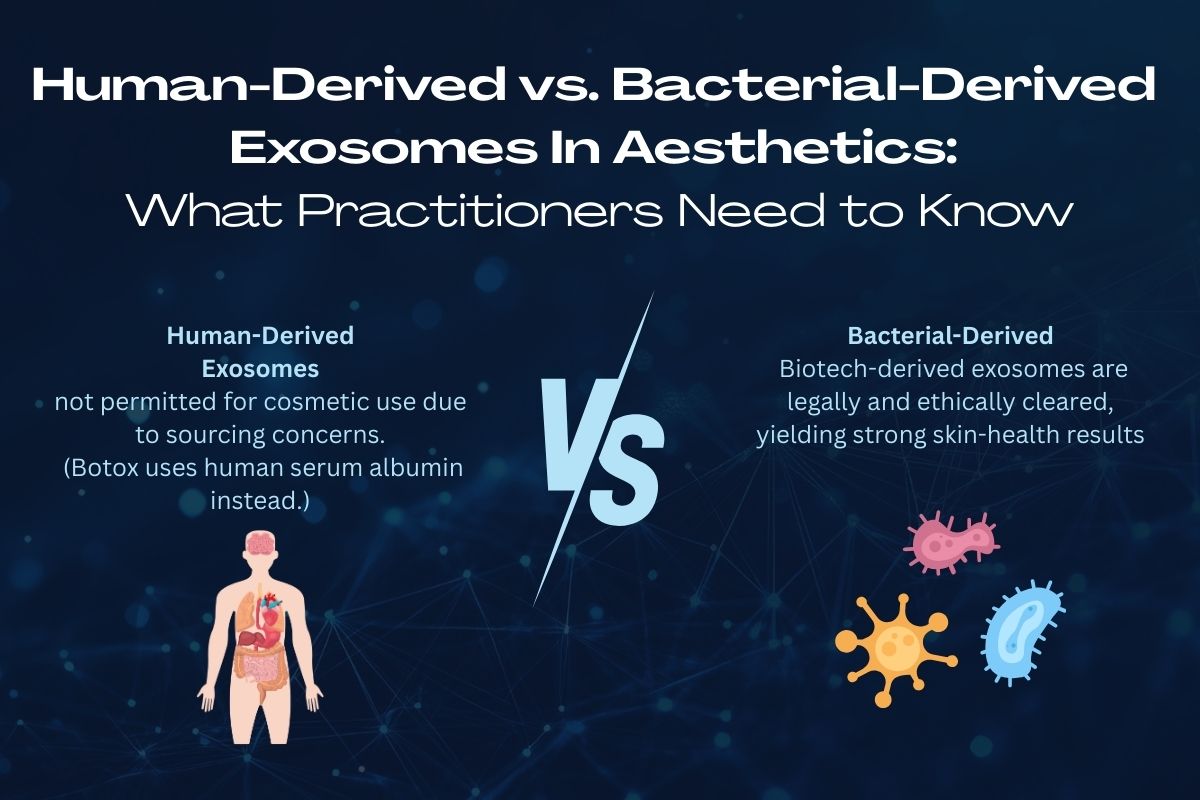
The answer lies not in the science alone, but in the sourcing, regulation, and approval of human-derived materials when used in cosmetics.
Botulinum Toxin: The Exception That Proves the Rule
Toxin contains human serum albumin (HSA), which is indeed human-derived. The key difference is that Botulinum Toxin is a licensed medical product. Every step of its sourcing, processing, and distribution is carefully regulated. The human albumin used is obtained under strict standards, fully screened, and approved for medical use worldwide.
As a result, practitioners and clients can have confidence that it meets the highest safety standards. The risk isn’t inherent in the material itself, but in how it is sourced and monitored. Botulinum Toxin has undergone decades of scrutiny and continues to be produced under the strictest regulatory frameworks.
Exosomes: Where the Red Flags Appear
Exosomes are a fascinating area of regenerative medicine. They’re tiny extracellular vesicles that play a role in cell communication and repair. The promise for skin health is enormous: improved texture, hydration, and rejuvenation at a cellular level.
However, when those exosomes are human-derived, the picture changes. For cosmetic use, there is no permitted pathway for sourcing human exosomes that meets the necessary ethical and regulatory standards. The questions become:
- Where did the donor material come from?
- How was it screened?
- Who approved it for use in elective, cosmetic procedures?
Right now, the answer is simple: they are not authorised for cosmetic use. That’s the central concern. It isn’t that “human-derived” is inherently unsafe. It’s that without a recognised regulatory framework, the risks outweigh the benefits, legally, ethically, and clinically.
The Rise of Bacterial/Biotech-Derived Exosomes
Revive NX: Bacterially Derived Exosomes with Human Compatibility
A strong example of this in practice is Revive NX, which uses exosomes derived from the probiotic bacterium Lactobacillus paracasei. This particular strain is not foreign to us; it naturally lives on and within the human body, which is why the exosomes it produces are highly compatible with our skin. The bacteria are carefully cultivated under controlled laboratory conditions, and from them, exosomes are harvested in a safe and reproducible way.
Because they are bacterially derived, these exosomes are far easier to mass-produce than anything sourced from human tissue. Their single-stranded DNA and simple cell structure make them consistent and reliable to manufacture, unlike human DNA, which is far more complex and variable. This simplicity allows for a product that is scalable, controlled, and safe while still carrying the biological “messages” that encourage repair and rejuvenation in the skin. Revive NX, therefore, offers practitioners the cutting-edge benefits of exosome therapy, but within a framework that is ethical, legally compliant, and scientifically sound.
This is where bacterial- or biotech-derived alternatives step in. Rather than relying on human donor tissue, these products are created using recombinant technology that mimics the regenerative properties of exosomes without the same sourcing concerns.
The results we’re seeing are impressive: improved skin health, better hydration, reduced inflammation, and overall rejuvenation. These alternatives are not only permitted for cosmetic use but also come with the reassurance that they avoid the ethical and legal pitfalls associated with human-derived materials.
In other words, practitioners can still harness the incredible potential of exosome technology, but do so within a framework that is transparent, safe, and compliant.
Plant-Derived Exosomes: Why They Don’t Match Up
Another option often mentioned in the conversation is plant-derived exosomes. On the surface, they sound appealing, natural, safe, and free of human or bacterial sourcing concerns. However, the problem is effectiveness.
Plant-derived exosomes do not carry the same cellular communication signals that human skin recognises. They lack the bioactive language needed to “speak” directly to our cells in the way that bacterial- or human-derived exosomes can. While they may offer some antioxidant benefits, they don’t achieve the same regenerative, restorative outcomes in skin health.
This is why, although plant-derived options exist, they aren’t considered a viable route for advanced skin rejuvenation. For practitioners seeking real results, the effectiveness just doesn’t compare.
Why This Matters for Practitioners and Clients
The aesthetics industry thrives on innovation. New technologies are constantly emerging, and clients are eager for treatments that deliver genuine results. However, as professionals, we bear the responsibility to ask:
Is this safe, legal, and ethical?
When it comes to exosomes, bacterial-derived products allow us to answer “yes” with confidence. They give us the tools to enhance skin health without straying into unregulated territory.
It’s important to remember: the issue is not “human-derived equals bad.” After all, Botox itself shows us that human proteins can be used safely when properly sourced. The issue is that cosmetic exosomes have not yet earned that approval, and until they do, we must tread carefully.
The question raised, comparing Botulinum Toxin with exosomes, was spot on. It highlights the importance of distinguishing between what’s scientifically possible and what’s legally and ethically permissible.
For now, the safest and smartest path is clear: embrace bacterial- or biotech-derived exosomes, which already deliver exceptional results for skin health. They bypass the sourcing concerns, align with regulations, and ensure practitioners can offer cutting-edge treatments without unnecessary risk.
In aesthetics, as in life, the details matter. And in this case, the detail is not the science of “human-derived” but the story of where it comes from.
Did you find this blog helpful?
We hope it has brought some clarity to what can be a complex and often daunting subject.
If you feel it may help someone else, a colleague, client, or friend, please do share it.
Reliable information deserves to reach beyond a single screen.
And if you are a qualified practitioner in microneedling and mesotherapy, and you’d like to dive deeper, enjoy a complimentary CPD opportunity with your first purchase of Revive NX Exosomes.
Follow Revive NX UK → \
Instagram → @revivenx_uk
TikTok → @revivenx_uk